Welcome to the Allergy Seal of Quality

Together we can make a difference
For manufacturers and retailers who want to bring their innovative products and services closer to the more than 23 million people living with allergies and intolerances in Switzerland and Germany, without missing growth targets – losing market shares to competitors – risking damage to their company's reputation
What is the Allergy Seal of Quality?
The Allergy Seal of Quality is a certification standard that marks products that are suitable for people with allergies and intolerances.
Why the Allergy Seal of Quality?
Trust: The Allergy Seal of Quality ggives consumers with allergies the confidence that the products they buy are safe for them.
Transparency: The Allergy Seal of Quality provides those affected with clear and reliable information about the products' tolerability.
Easier shopping: The Allergy Seal of Quality enables consumers to quickly identify products that are suitable for them, making it easier for them to make purchasing decisions.
Two thirds of the Swiss population are familiar with the Allergy Seal of Quality
To better understand the benefits and perceptions of the Allergy Seal of Quality, we conducted market research. We surveyed 1000 people aged between 18 and 79 from all over Switzerland. The aim of the survey was to find out whether the Allergy Seal of Quality influences the purchasing decisions of allergy sufferers and their families. Discover the key findings of the survey on the right, or download the PDF.
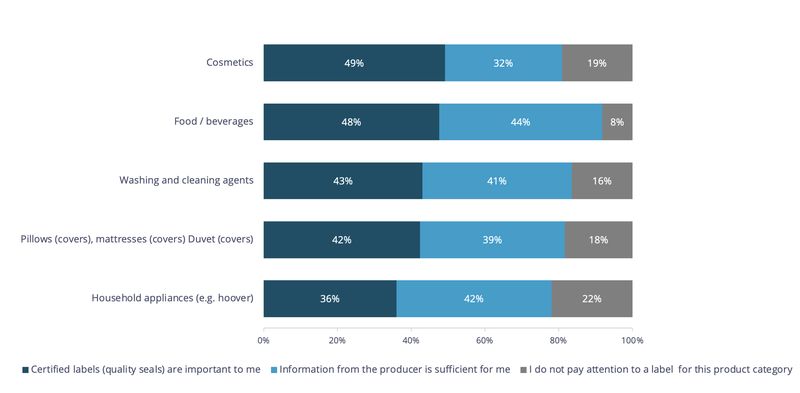
People who pay special attention to labelling attach particular importance to quality seals for cosmetics. For food and drink, both seals of quality and product-specific information from manufacturers are important.
- The Allergy Seal of Quality is particularly well known among women, younger people and those affected.
- Approximately half of the Swiss population has already used products bearing the Allergy Seal of Quality; as expected, this proportion is higher among those with allergies.
- Approximately one third of consumers look for the Allergy Seal of Quality when shopping.
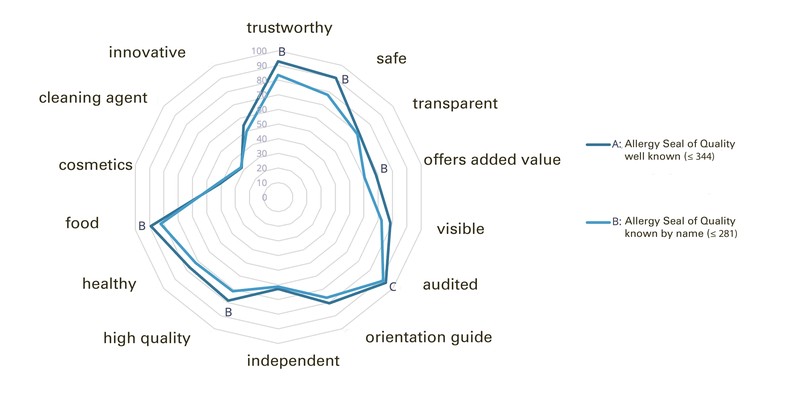
- The Allergy Seal of Quality has a reputation as a trustworthy and controlled label.
- The Allergy Seal of Quality is most often associated with food (85%), followed by cosmetics (41%) and cleaning products (41%).
People who are familiar with the significance of the Allergy Seal of Quality find it as particularly trustworthy and reliable. They recognise a higher added value in it, associate it with quality, and therefore rate the benefits of the Seal of Quality higher.
Reach new target groups in a fast-growing market. In Switzerland and Germany, more than 23 million people are affected by allergies and intolerances. And the numbers are growing.
By using the Allergy Seal of Quality, your brand is highlighted as allergen-optimised and can be perceived as responsible and customer-oriented.
A certification is a distinct competitive advantage. The market for special products is growing strongly and retailers are recording growth rates of up to 20 per cent.
The Allergy Seal of Quality can be a unique selling point. It gives manufacturers a competitive advantage in a highly competitive market.
With certified products, you meet the demands of people with allergies and intolerances and have the opportunity to win new customers.
Our certification standards
- We check what the product does not contain.
- We have clear and measurable values.
The Allergy Seal of Quality stands for strict quality standards and regular inspections. In this way, we ensure that the products always meet our requirements.
Criteria for a certification
In order for food and beverages to be certified, at least one allergy-inducing ingredient (e.g. gluten or lactose) must be demonstrably removed using suitable processes so that a certain limit value is not exceeded. The organisation must also have an appropriate allergen management system in place. Under certain conditions, food and beverages that do not naturally contain the allergy-inducing substance can also be certified.
In order for cosmetics to be certified, they must contain the 81 potentially allergenic substances in only very limited quantities. The Allergy Seal of Quality bans them at concentrations that are 10 times lower than specified by Swiss law. In addition to the basic requirements listed above, the claims "without perfume/without fragrances" and "without dyes" are also tested if they are advertised or used on the packaging.
In order for technical products to be certified, allergens must be kept away from allergy sufferers in accordance with a specified percentage through removal (vacuum, washing), filtration (filtration), or retention (barrier). However, certified vacuum cleaners do not necessarily have to be equipped with a dust collection bag.
Depending on the desired claim (e.g. for sensitive skin), the applicable requirements regarding chemical and mechanical irritation of the skin must be observed. Requirements for latex and latex substitutes, silk, and textile floor coverings are also regulated.
In order for mite protection covers (encasings) to be certified, allergens must be kept away from allergy sufferers to a specified percentage degree by retaining the allergens (barrier).
In order for hygiene articles to be certified, they may contain the 81 potentially allergenic compounds, azo and disperse dyes, formaldehyde, nickel and chromium (VI) only in very limited quantities.
In addition to the above-mentioned basic requirements, the claims "without perfume / without fragrances", "without dyes" and "without latex" are tested if these claims are advertised or used on the packaging.
Catering establishments with the Allergy Seal of Quality can cater to the needs of people with allergies and intolerances.
In order for catering establishments to be certified, they must have a tested allergen management system and employees must be trained so that they can provide information about ingredients that can trigger allergies and intolerances in the food and drinks on offer.
Establishments that deal with food allergies and intolerances can communicate directly and in a focussed manner with a very large target group and benefit from satisfied and returning guests.

Do you have any questions about the Allergy Seal of Quality or the certification of your products? We will be happy to advise you and accompany you all the way to certification. Give us a call or book an appointment.